
Introduction
I wrote a blog last week concerning the COVID-19 crisis that contained some world map visualizations of metrics I find to be useful in analyzing the situation. This week I am updating my study to reflect this week’s changes as well as adding in visualizations to look at the data at the US state level. COVID-19 is affecting countries all over the world and in many places the number of cases is growing exponentially everyday. This blog post with the associated Jupyter Notebook will look at different measures of how bad the outbreak is across the world and in the United States. Each metric will be displayed in a global or US choropleth map. Additionally, this exercise sets up repeatable code to use as the crisis continues and more daily data is collected.
Disclaimer
The point of this blog is not to try to develop a model or anything of the sort to detect COVID-19, as a poorly created model could cause more harm than good. This blog is simply to generate visualizations based on publicly available data about COVID-19. These visualizations will ideally help people understand the global effect of COVID-19 and the exponential pace at which cases are developing across the world and in the United States.
Data Sources
Again, the data used in this analysis is all publicly available data. The COVID-19 global daily data has been provided from the European Centre for Disease Prevention and Control. This data source is updated daily throughout the crisis and can be used to update this exercise regularly going forward. The US State level COVID-19 data has been made publicly available by the New York Times in a public GitHub Repository. In addition to the COVID-19 data, global and US state population data was used to provide per capita metrics. The global data is from The World Bank, while the US State level population data is from The United States Census Bureau.
Python Code Access
If you are interested in seeing the code used to generate these visualizations, the python code and Jupyter Notebook can be found on GitHub.
Results
To begin, global results as of 3/20/20 can be found in previous blog.
As a reminder, the five metrics I will be viewing at both a country level and US state level are the following:
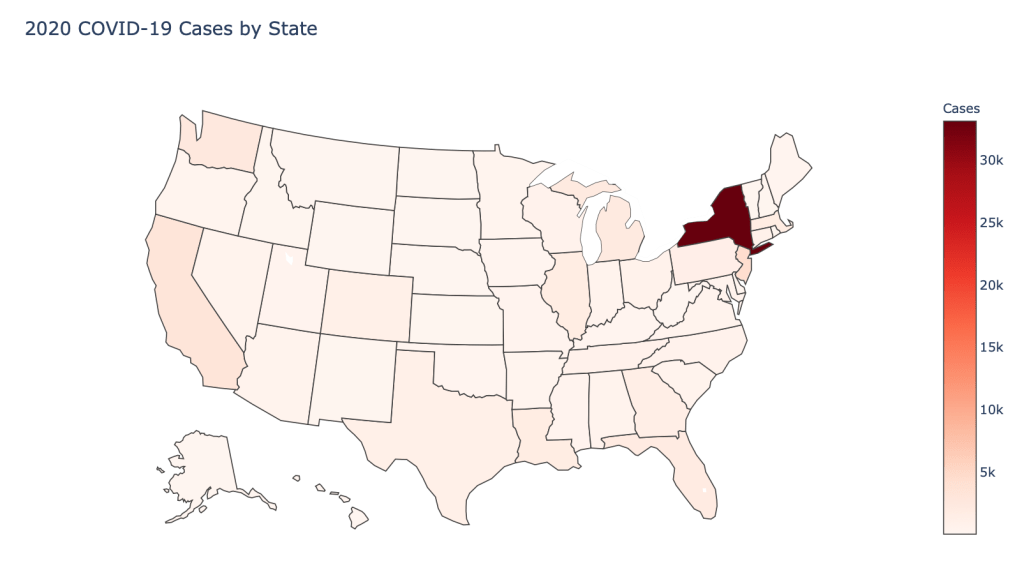
- Number of 2020 Cumulative Cases
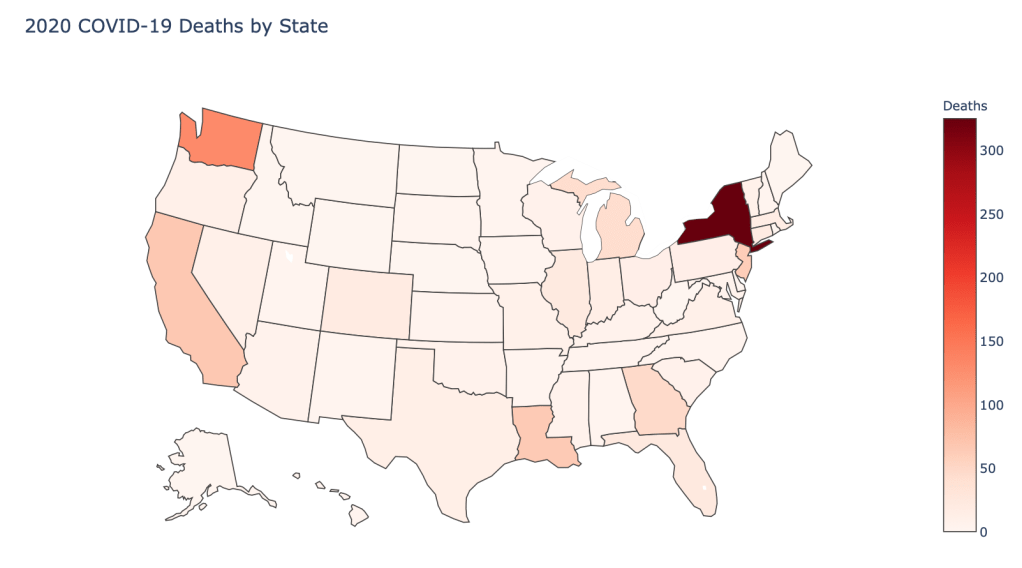
- Number of 2020 Cumulative Deaths
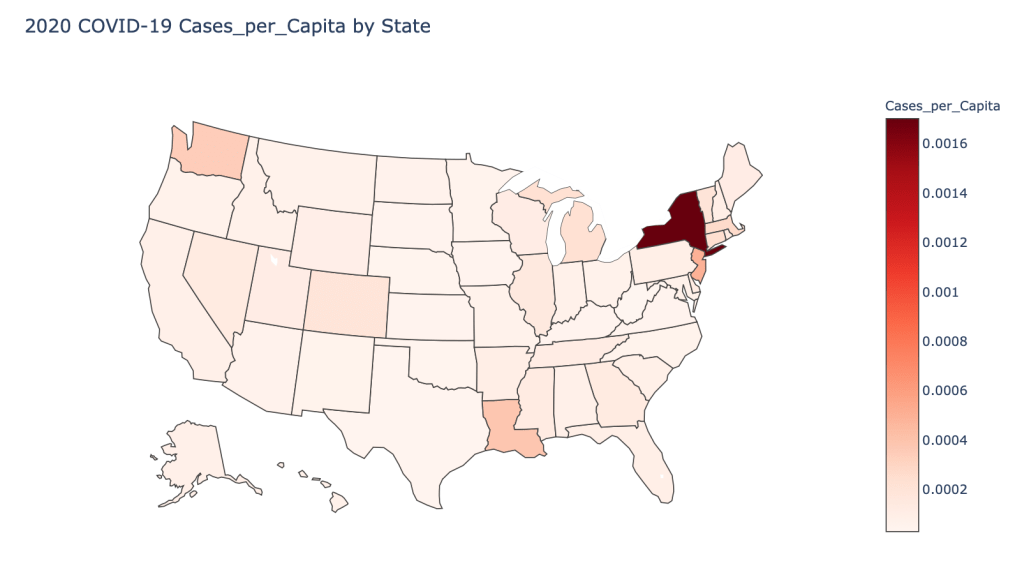
- 2020 Cases per Capita
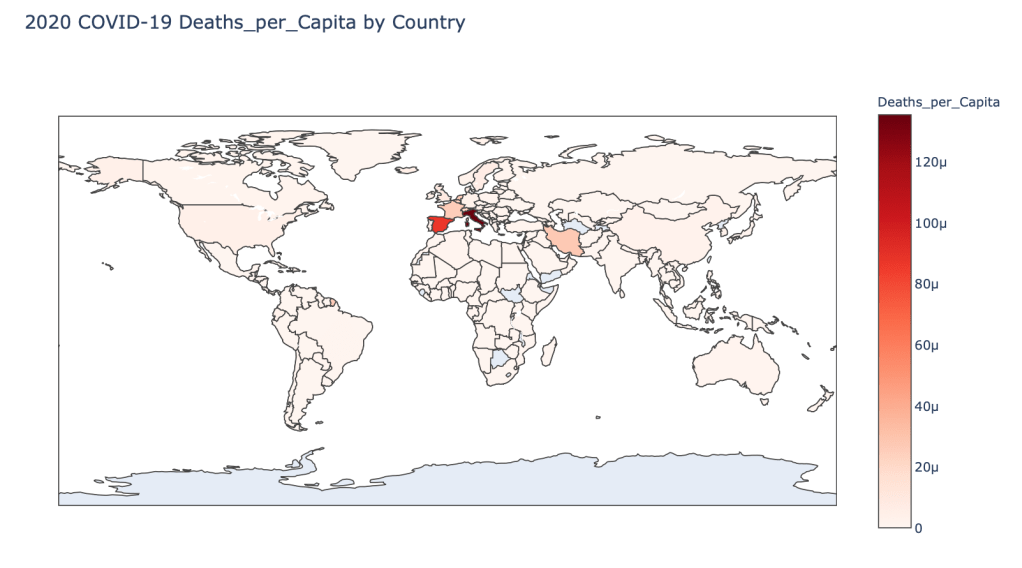
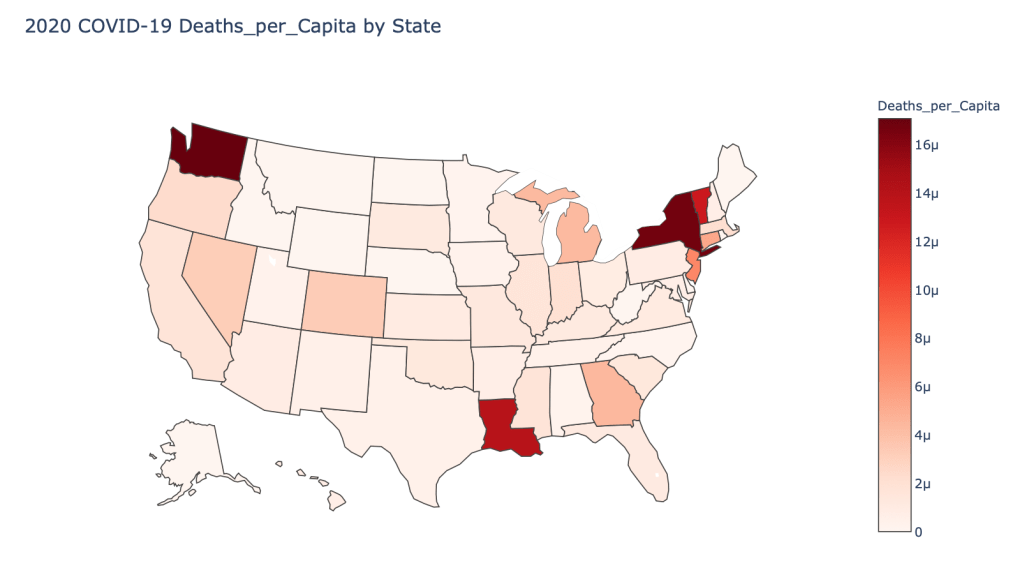
- 2020 Deaths per Capita
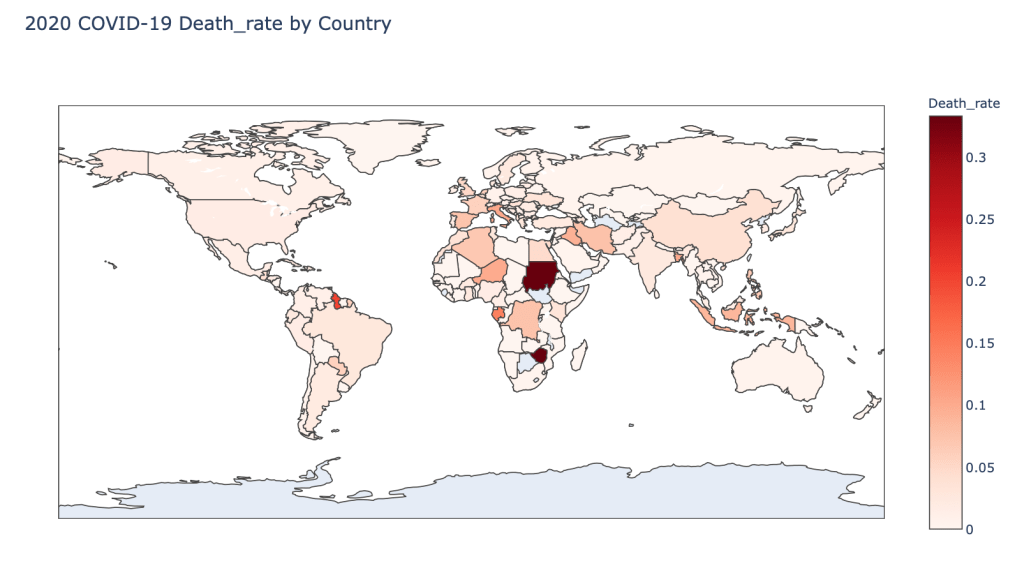
- 2020 Death Rate
In this blog post, the global results are as of 3/27/20, while the US state level results are as of 3/25/20.
Global Results – 3/27/20


US State Level Results – 3/25/20

Conclusions
As you can see by looking at the various metrics, certain countries are handling the virus better than others. China and the United States have many cases, but in comparison to their overall population, the number of cases is not that high. European countries like Iceland, Spain, and Italy have a high amount of cases per capita. Unfortunately, when looking at the death rates, places with less medical resources seem to have higher death rates, such as Sudan, Zimbabwe or Guyana, caveat these rates with very low number of cases so far however. European countries on the other hand are not low either with high numbers of cases.
In the United States, certain states are facing worse COVID-19 circumstances than others. New York, Washington, and California have a lot of cases. States like Louisiana, Vermont, Washington, and New York have a lot of deaths per capita. Death rates seem to be fairly evenly spread throughout the states.

 import Data_Science as Ben
[…] Global results as of 3/27/20 and US results as of 3/25/20 can be found in this previous blog. […]
LikeLike
[…] Global results as of 3/27/20 and US results as of 3/25/20 […]
LikeLike
[…] Global results as of 3/27/20 and US results as of 3/25/20 […]
LikeLike
[…] Global results as of 3/27/20 and US results as of 3/25/20 […]
LikeLike
[…] Global results as of 3/27/20 and US results as of 3/25/20 […]
LikeLike
[…] Global results as of 3/27/20 and US results as of 3/25/20 […]
LikeLike
[…] Global results as of 3/27/20 and US results as of 3/25/20 […]
LikeLike
[…] Global results as of 3/27/20 and US results as of 3/25/20 […]
LikeLike
[…] Global results as of 3/27/20 and US results as of 3/25/20 […]
LikeLike
[…] Global results as of 3/27/20 and US results as of 3/25/20 […]
LikeLike
[…] Global results as of 3/27/20 and US results as of 3/25/20 […]
LikeLike
[…] Global results as of 3/27/20 and US results as of 3/25/20 […]
LikeLike
[…] Global results as of 3/27/20 and US results as of 3/25/20 […]
LikeLike
[…] Global results as of 3/27/20 and US results as of 3/25/20 […]
LikeLike